About


2018–2021: AI Action Plan 1.0 (capacity foundation)
Built national AI talent, semiconductor–AI integration, and digital infrastructure capacity.
Enterprise Security Relevance: Strengthened domestic AI capabilities and supply chain resilience, reducing dependency risk and improving control over critical AI infrastructure used by enterprises.
Sep 1, 2021: Taiwan Smart Healthcare Alliance (TSHA) established Cross-institution AI healthcare validation network.
Enabled regulated AI clinical trials and TFDA-aligned evaluation.
Established secure validation pathways for regulated AI systems, reducing liability exposure and ensuring healthcare AI systems meet compliance and data protection standards.
Nov 4, 2021: Taiwan Federated Learning Medical Alliance (FLMA) founded Privacy-preserving cross-hospital AI collaboration.
Federated learning architecture keeps patient data localized.Demonstrates a scalable privacy-by-design AI model that reduces centralized data breach risk and supports enterprise-grade data governance compliance.
2019–2022: Expansion of AI-enabled defense R&D AI integration into drones, ISR, maritime monitoring, autonomous systems.
Advanced AI in autonomous systems drives innovation in edge AI, cybersecurity hardening, and resilient system architecture applicable to critical infrastructure and enterprise security.
2022–2024: AI-enabled unmanned systems acceleration Drone swarm experimentation, edge AI for battlefield analysis.
Accelerated development of distributed AI systems improves resilience against single-point failure risks and strengthens secure edge computing models relevant to enterprise environments.
2023: Undersea cable regulation strengthened Amendments to Telecommunications Management Act protecting submarine cables.
Enhances protection of critical digital backbone infrastructure, directly reducing enterprise exposure to connectivity disruption, supply chain interruption, and systemic operational risk.
2023: FedGPT architecture development initiated
Goal: Build a trustworthy, federated, Traditional Chinese LLM with verifiable output capability.
Reduces reliance on opaque third-party LLM platforms, lowering risks related to data sovereignty, cross-border data exposure, and embedded bias.
Jan 26, 2024: Taiwan AI Labs launches FedGPT,600+ billion token Traditional Chinese large language model.
Provides public and private sectors with a locally governed, transparent AI model option aligned with compliance, data security, and internal governance requirements.
2024–2025: FedGPT ecosystem expansionIntegration into healthcare, financial, and public-sector use cases.
Creates government and enterprise-grade AI infrastructure that supports sensitive-sector deployment without exposing proprietary or regulated data to external model providers.
Apr–Jun 2023: AI Taiwan Action Plan 2.0 announced
Emphasizes governance, federated AI, regulatory testbeds.
Creates structured AI governance frameworks that reduce government and enterprise regulatory uncertainty and operational risk.
May–Jun 2023: Executive Yuan Anti-Fraud Office inaugurated Whole-of-government anti-scam ecosystem.Strengthens cross-sector fraud detection capabilities, protecting enterprises from AI-driven impersonation attacks and financial loss.
Oct 16, 2023: Eagle Eye Anti-Fraud Alliance launched
Banking,telecom and law enforcement coalition.Demonstrates multi-stakeholder AI-based fraud monitoring architecture that enterprises can integrate into risk management strategies.
Oct 17, 2023: FSC finance AI “Core Principles” issued AI risk management framework for financial institutions.
Introduces lifecycle AI governance standards that reduce operational, compliance, and reputational risks for enterprises deploying AI systems.
Cognitive Security & Information Resilience (Taiwan AI Labs Track)
2020–2023: Infodemic platform development
Real-time narrative tracking and coordinated behavior detection.Enhances enterprise capacity to detect FIMI (Foreign Information Manipulation and Interference), brand manipulation, and reputational attacks amplified by AI systems.
Apr 17, 2024: 2024 Taiwan Election Cyber Info Manipulation Report published
First LLM-supported large-scale cognitive warfare analysis.
Provides analytical methodologies for identifying coordinated AI-amplified campaigns that enterprises can adapt for cybersecurity and brand protection monitoring.
Jun 20, 2024: FSC finance AI Guidelines issued
Operational lifecycle governance requirements.
Strengthens enterprise AI governance maturity models and clarifies accountability standards.
Jul 15, 2024: NSTC Draft AI Basic Act consultation opened
National principles-based AI governance framework.
Signals predictable regulatory direction, reducing long-term compliance uncertainty for enterprises.
Jul 31, 2024: Fraud Crime Hazard Prevention Act effective
Cross-sector legal authority linking finance, telecom, and platforms.Enhances systemic fraud mitigation infrastructure, lowering enterprise exposure to AI-driven scams.
Nov 2024: Anti-fraud strategy guidelines 2.0 released
Strengthens AI-driven prevention and cross-border enforcement.
Improves institutional coordination against AI-enabled cybercrime impacting enterprises.
Jan–Apr 2025: MODA Public Sector AI Playbook rollout
AI governance procedures for government agencies.Provides governance best practices that enterprises can mirror to strengthen internal AI risk assessment and procurement standards.
Apr 8, 2025: National Security Bureau reports rising AI-assisted disinformation operations
Formal recognition of AI-enabled hybrid threat landscape.Highlights the growing reputational and operational risks enterprises face from AI-driven misinformation and synthetic media campaigns.
Key regulatory participating and compliance developments
Aug 28, 2025: Executive Yuan approves draft AI Basic Law
Dec 23, 2025: Legislative Yuan passes AI Fundamental Act
Jan 14, 2026: AI Fundamental Act enters into force
Establishes legal baseline for human rights, transparency, accountability.
Creates a predictable compliance environment and clarifies enterprise obligations for responsible AI deployment.
By 2026, Taiwan’s AI strategy forms a comprehensive government and enterprise security–aligned AI governance architecture:
Legal Framework : Predictable AI compliance environment
Financial AI Defense : AI-enabled fraud mitigation ecosystem
Cognitive Security : Brand & reputation protection capability
Sovereign LLM (FedGPT) : Data sovereignty & model governance control
Defense AI Innovation : Secure edge AI & resilient distributed systems
Infrastructure Protection : Digital backbone continuity assurance
Taiwan’s AI governance evolution demonstrates:
1.Secure AI deployment under high-risk digital conditions
2.Federated and privacy-preserving AI architecture
3.Trusted LLM development (FedGPT) with governance controls
4.Cross-sector fraud mitigation infrastructure
5.Legal codification of responsible AI principles
Taiwan represents a practical case study of AI governance aligned with enterprise security, resilience, and digital sovereignty.
Taiwan AI labs formed a strategic partnership with DS Federal, a leader in U.S. health IT and data analytics, to introduce innovative solutions to the U.S. public health and national security markets.
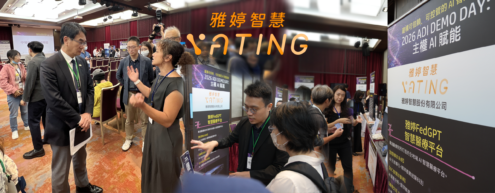 https://ailabs.tw/wp-content/uploads/2026/09/雅婷智慧數產署智慧醫療參展團隊照-1.png
1000
2560
ailabspr
http://ailabs.tw/wp-content/uploads/2025/05/ailabs_logo-2.png
ailabspr2026-09-10 13:25:482026-09-10 13:25:48Yating Intelligence Debuts at ADI DEMO DAY, Showcasing "Four Core Healthcare Solutions" with Practical Implementation Becoming the Event's Highlight
https://ailabs.tw/wp-content/uploads/2026/09/雅婷智慧數產署智慧醫療參展團隊照-1.png
1000
2560
ailabspr
http://ailabs.tw/wp-content/uploads/2025/05/ailabs_logo-2.png
ailabspr2026-09-10 13:25:482026-09-10 13:25:48Yating Intelligence Debuts at ADI DEMO DAY, Showcasing "Four Core Healthcare Solutions" with Practical Implementation Becoming the Event's Highlight https://ailabs.tw/wp-content/uploads/2026/09/0902數發部首份主權-AI-評測揭曉!雅婷智慧-FedGPT-奪台灣模型三冠王-30B-輕量全地端架構開創企業主權新局_雅婷智慧董事長廖群_右二-1-e1788947311435.jpg
1129
2477
ailabspr
http://ailabs.tw/wp-content/uploads/2025/05/ailabs_logo-2.png
ailabspr2026-09-10 08:14:292026-09-10 08:14:29Ministry of Digital Affairs Unveils First Sovereign AI Evaluation Results! Yating Intelligence's FedGPT Claims Triple Crown Among Taiwanese Models; 30B Lightweight, Fully On-Premise Architecture Pioneers a New Era for Enterprise Sovereign AI
https://ailabs.tw/wp-content/uploads/2026/09/0902數發部首份主權-AI-評測揭曉!雅婷智慧-FedGPT-奪台灣模型三冠王-30B-輕量全地端架構開創企業主權新局_雅婷智慧董事長廖群_右二-1-e1788947311435.jpg
1129
2477
ailabspr
http://ailabs.tw/wp-content/uploads/2025/05/ailabs_logo-2.png
ailabspr2026-09-10 08:14:292026-09-10 08:14:29Ministry of Digital Affairs Unveils First Sovereign AI Evaluation Results! Yating Intelligence's FedGPT Claims Triple Crown Among Taiwanese Models; 30B Lightweight, Fully On-Premise Architecture Pioneers a New Era for Enterprise Sovereign AI https://ailabs.tw/wp-content/uploads/2026/08/新聞稿上架-0828-3.png
800
2400
ailabspr
http://ailabs.tw/wp-content/uploads/2025/05/ailabs_logo-2.png
ailabspr2026-08-28 18:21:122026-09-11 14:15:40Taiwan’s Leading On-Premises AI Model Arrives! Yating Intelligence FedGPT Sweeps National AI Benchmark with Record-Breaking “Triple Crown”
https://ailabs.tw/wp-content/uploads/2026/08/新聞稿上架-0828-3.png
800
2400
ailabspr
http://ailabs.tw/wp-content/uploads/2025/05/ailabs_logo-2.png
ailabspr2026-08-28 18:21:122026-09-11 14:15:40Taiwan’s Leading On-Premises AI Model Arrives! Yating Intelligence FedGPT Sweeps National AI Benchmark with Record-Breaking “Triple Crown”




Name :財團法人台灣人工智慧發展基金會
Account :153-018-0006262-9
Bank No : 807
Swift Code : SINOTWTP
To download the complete version of the research paper, please submit the request form at the end of this blog